Screen-Free & Unplugged
What Kids Actually Learn at an Unplugged Summer Camp

Parents ask what their child will get out of two weeks at camp, and the honest answer is that it is almost never the activities.
They will learn to shoot a bow, more or less. They will get better at a paddle board. None of that is why they come home different, and none of it is why they beg to come back for eight straight summers.
What actually changes is subtler and harder to sell on a website, so it is worth being specific about. Camp Huawni has run completely phone-free sessions in the East Texas Piney Woods since 1965. Here is what we watch children pick up in a week or two without a screen — and, more usefully, the mechanism behind each one, so you can judge whether it matters to your family.
1. That boredom is survivable, and then productive
The first two days of a session are the hardest, and they are hardest in a very particular way: campers who have never had ten unfilled minutes find unstructured time genuinely uncomfortable.
Then, somewhere in day three, they start doing things. Building something out of what is lying around. Inventing an elaborate game with rules only the cabin understands. Wandering down to the pond because there is nothing else to do and the pond is there.
That transition is the single most valuable thing a phone-free session produces, because it restores a capacity that has quietly gone missing from childhood. Boredom is not a problem to be solved; it is the pressure that makes a child generate something. A phone eliminates it entirely, and with it the whole class of things children used to invent in the gaps.
The reassuring part for parents: it comes back in about four days. It is out of practice, not gone.
2. How to repair a conflict with someone you cannot leave
At home, a disagreement with a friend can be exited. You go home. You stop replying. The friendship pauses and resumes on your terms.
In a cabin of a dozen kids for two weeks, there is no exit. You had an argument at breakfast and you will be sitting next to that person at dinner, and at the campfire, and in the bunk above them tonight. So it gets worked out — awkwardly, imperfectly, usually with a counselor nearby but not intervening.
This is one of the few remaining settings where children have to practice repair. It is not comfortable and it is not always pretty, and it is a skill that transfers to every relationship they will have. At Camp Huawni cabins hold a maximum of 14 campers with two counselors, which is small enough that nobody disappears into the group and every conflict has to be actually resolved rather than absorbed.

3. That they are more capable than they thought
Every camp claims to build confidence, which has made the word useless. The mechanism is what matters.
Confidence at camp does not come from being told they are capable. It comes from a specific sequence: a child is faced with something they are not sure about — the high ropes course, the twenty-foot swing, sleeping in an open-air cabin the first night, the camper triathlon — and they do it, and nobody made them, and nobody was there to see whether they would.
The absence of a phone matters here more than it sounds. A camper with a phone has a parent in their pocket during the exact moment of hesitation. That is comforting and it short-circuits the thing. The decision has to be theirs, made alone, for the result to belong to them.
4. How to talk to people of different ages
A modern child's social world is remarkably age-segregated. School sorts by birth year, activities sort by skill band, and the group chat is all peers.
Camp is not. A cabin has a two- or three-year spread, counselors are college students in their late teens and early twenties, and the whole camp — 100 to 170 people — eats together, competes together in Tribal Competition, and sings together at the end of the night.
The counselor relationship is the underrated part. A nineteen-year-old is close enough in age to be genuinely cool and far enough to be an adult. Campers will tell a counselor things they would not tell a parent or a teacher, and a good counselor knows what to do with that. Our staff of about 50 college-aged counselors, at a 3.2 to 1 camper-to-staff ratio last summer, is most of what the tuition actually buys.
5. That there is a version of themselves not built out of an audience
Every child with a phone is, to some degree, performing. Not cynically — it is simply the water they swim in. There is a version of them that exists for other people to see, and it is maintained.
Two weeks with no phone dismantles it, because there is no audience beyond the twelve people in the cabin, and those twelve have seen you at 7am with bad hair and a bad attitude. There is no maintaining anything.
What parents describe on closing day is a kid who is louder, sillier, less self-conscious, and more themselves. That is not the camp adding something. It is two weeks without the performance, and what is underneath turning out to be perfectly good.
Our founders, Earl and Retha Adams, started this place in 1965 with the stated intent of creating somewhere children could truly be themselves. Sixty summers later the mechanism turns out to be partly about what is absent.
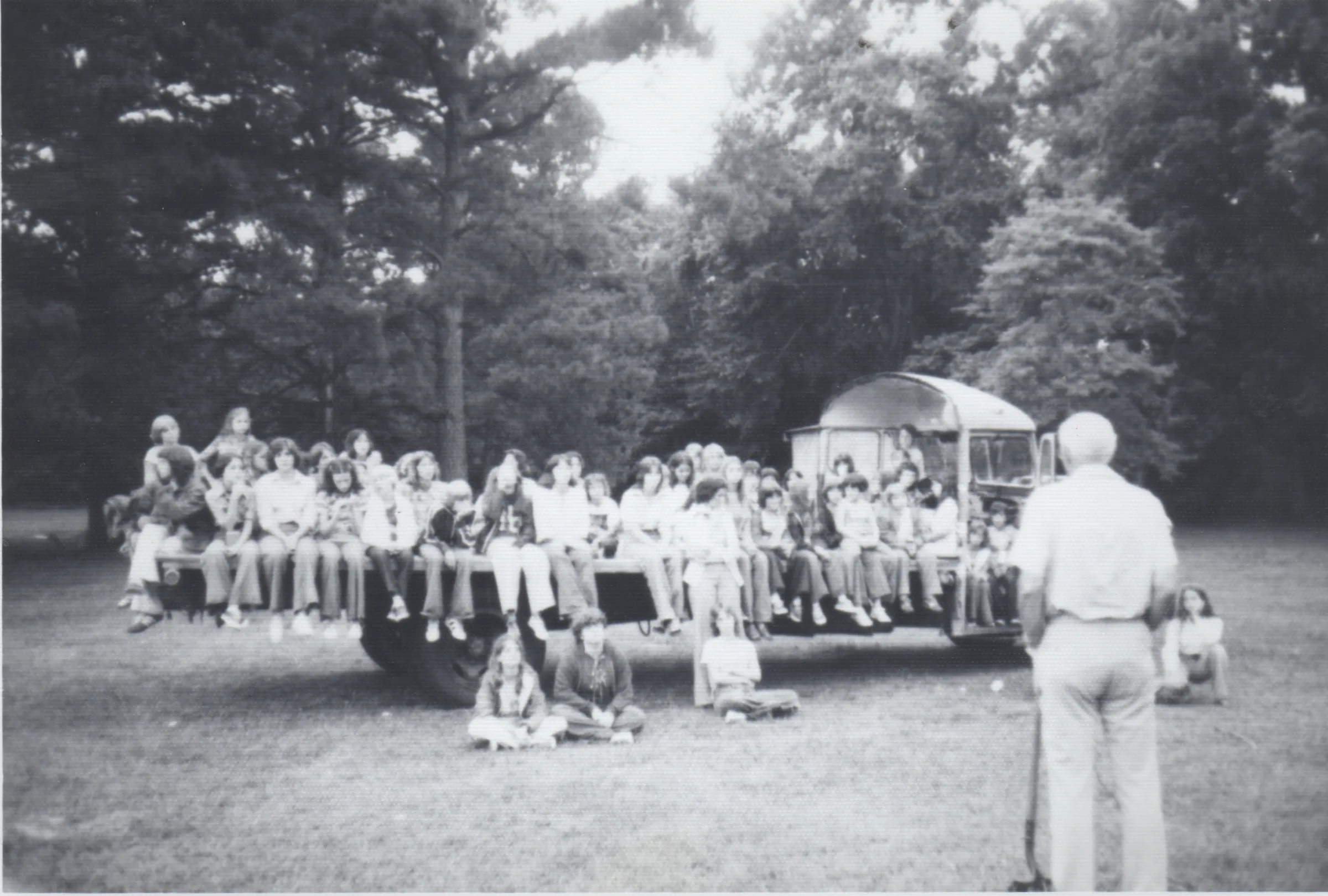
6. That traditions are worth belonging to
This one is hardest to explain to someone who has not seen it, and it is the reason campers come back for a decade.
At Huawni, camp splits into the red Caddo and the blue Tejas for Tribal Competition, and the winning tribe's flag flies over Flagpole Hill until the following summer. Campers hike to the Carving Trees and carve their names into a beech tree beside a carving from 1968. On the last night, the whole camp gathers under the Summer Tree, where campers say out loud to a sibling or a friend something they have never said, and then first-year campers are initiated into the Tribe of Huawni.
None of that is programmable. It works because it is old, because the counselor running it was a camper who did it, and because it belongs to a specific place. A child who has been part of something with sixty years of continuity has a different relationship to institutions than one who has not.
Why the phone policy is the load-bearing part
Everything above is a claim about traditional camp generally. What the phone-free policy contributes is that it applies to everyone at once.
This is the thing home rules cannot replicate. A child who puts their phone down at home is the only one who did. Their friends are still in the chat, still posting, and the sense of missing something is real and constant. That cost is why home limits are so hard to sustain — and it is not the child's fault.
In a cabin where nobody has a phone, and where it is not a rule being policed but simply the shape of the world for two weeks, that cost disappears. There is nothing to miss because nothing is happening anywhere else. What fills the space is the eleven other people in the room.
Policies vary a lot across camps. Some allow phones freely, some collect them and return them at set times, some do not allow them on the property at all. Camp Huawni is in the last group and always has been. It is worth deciding your own position before you tour anywhere, because a family that spends the session fighting the policy has a worse time than a family who chose a camp that matched them. We have written about the signs a child needs a break and about running a screen-free stretch at home if you want to test the idea before committing to a session.
What that looks like in practice
Camp Huawni is a traditional, coed overnight camp on 600-plus acres of Piney Woods outside Timpson, in East Texas. Campers are 7 to 17, in narrow cabin age bands across 14 cabins on Flagpole Hill. Sessions are one week or two. Days are six outdoor activity periods — archery, high ropes, the giant swing, mountain bikes, canoes and paddle boards on our own pond, the giant water slide, swimming, hiking — and nights are the traditions.
No phones. Since 1965.
If you want the detail: a typical day at camp, the full activity list, what cabin life is like, or this summer's dates and rates. If you are still comparing camps across the state, our parent's guide to the best summer camps in Texas is a framework rather than a pitch, and it will make every camp tour you take more useful.
Frequently asked questions
- What is an unplugged summer camp?
- A camp where campers do not have phones or personal devices during the session. Policies vary — some camps collect phones and return them at set times, others do not allow them on the property at all. Camp Huawni is in the second group and has been since 1965.
- How do parents communicate with campers at a no-phone camp?
- Letters, and usually an online photo portal where families can see pictures from the session. Most phone-free camps have replaced device contact with something, and it is worth asking specifically what before you enroll.
- Do kids struggle without their phones at camp?
- For about two days, yes. Counselors expect it. Somewhere in the third or fourth day the asking stops, not because the rule has been accepted but because something more interesting has filled the space. Parents are consistently surprised by how fast this happens.
- Is a phone-free camp better than one that allows limited phone use?
- It depends on the family. What a full ban buys is that the entire peer group is off at once — nobody is missing a group chat, because the group chat does not exist for two weeks. Limited-use policies do not produce that effect. But a family that genuinely wants contact will have a better summer at a camp whose policy matches their preference.
Come see Huawni for yourself
One-week and two-week sessions in the Piney Woods of East Texas, running since 1965. Check this summer's dates and rates, or have us send you the full parent packet.
Keep reading
- Signs Your Child Needs a Phone Break Eight specific, observable signs that a child's relationship with their phone has tipped — and what to do about it that does not start a war. Written by a camp that has run phone-free sessions since 1965. 7 min read
- How to Do a Screen-Free Summer with Your Kids A practical plan for cutting screens back over a summer without a war — what to expect in the first week, how to fill the hours, and why going all the way to zero for a stretch works better than moderation. 6 min read
- The Best Summer Camps in Texas: A Parent's Guide How to compare overnight summer camps in Texas — camp types, session length, real cost ranges, accreditation, ratios, and phone policy — plus a 12-question shortlist you can take to any camp tour. 19 min read