
Cabin Life
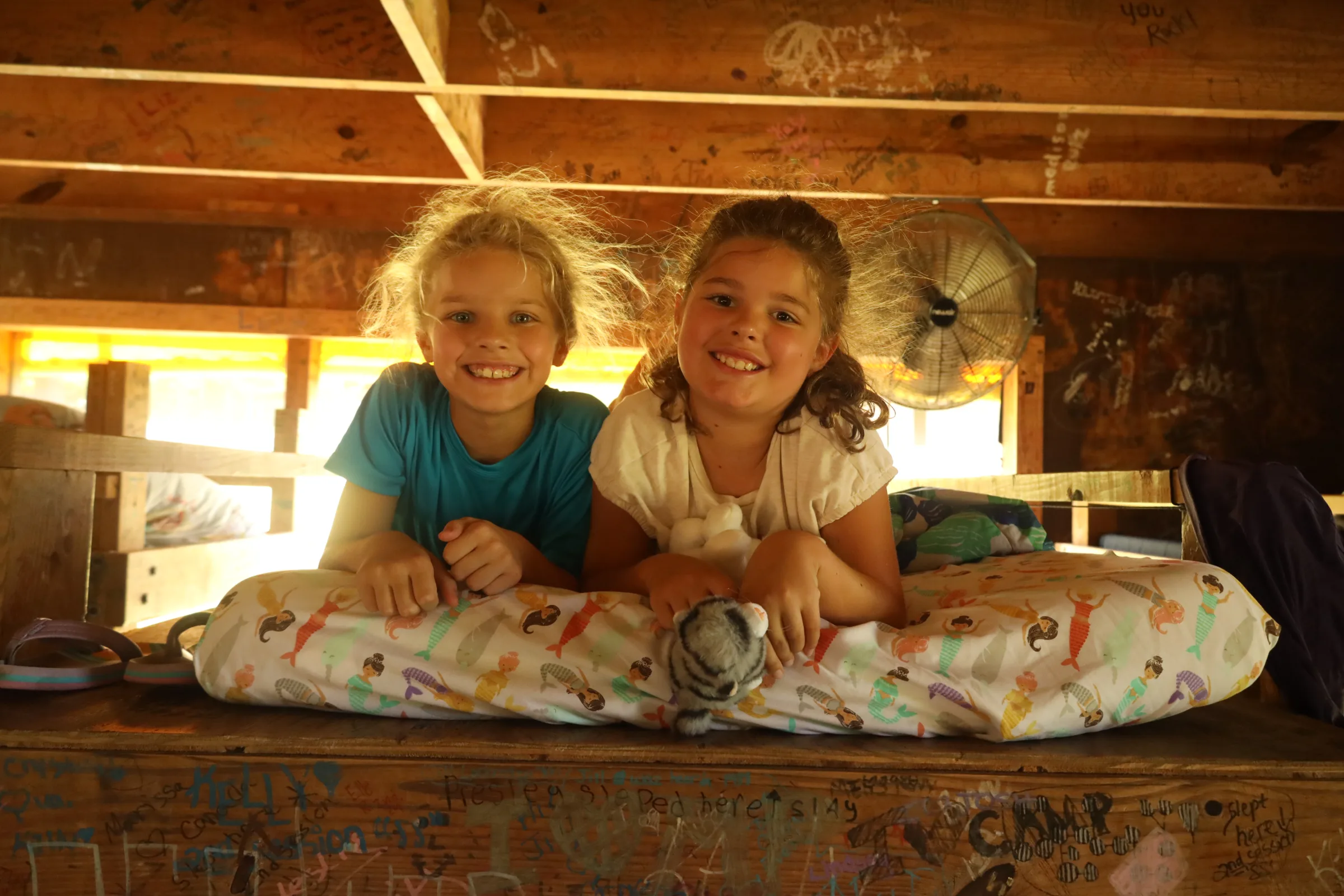
Ever see the movie The Parent Trap? Cabin life at Huawni is like living in your very own Parent Trap cabin, where you get to do all sorts of stuff you can’t do at home…like writing your name on the wall! You’ll get to experience the joys of sleepaway camp as the crickets and frogs sing you to sleep each night. If you live in the city, you’re going to especially love our summer camp cabins because you can see the stars right outside your window, brighter and bigger than ever before.
Open Air Cabins = Unplugging & Collaborating
So why stay in an open-air cabin for two, four, or six weeks with 8-12 other kids? Believe it or not, the cabin experience promotes several critical skills that children so desperately need. The “Partnership for 21st Century Skills” recently found that the three most critical skills for children include oral communication, collaboration, and creativity, all of which are amplified in the cabin. Living in a cabin with other children, some not of your child’s choosing, promotes 24/7, face-to-face interaction and opportunities for collaboration. A good friend and summer camp advocate Steve Baskin hits the nail on the head with this TEDx talk.
Unplugging Our Kids: Steve Baskin at TEDxSanAntonio
Cabin Traditions & Bucket List - Why You’ll Never Want To Miss Another Summer
Every cabin tradition is extra special at Camp Huawni. This is the one, big, sleepaway camp event that only your cabin gets to participate in during camp. Every year that you come back and move into an older cabin, you get to do a new cabin tradition. Cabin traditions for girls include The Princess Ball, Movie Night at the Pool, Destination Sing Song, and Star Tripping. Cabin traditions for boys include Mission Impossible, Night Scavenger Hunt, Night Hike, and The Ultimate Pillow Fight.
Is Camp Huawni like the camp in The Parent Trap?
People search for this more than you would guess, and it is a fair question — for a lot of families, that movie is the only picture of sleepaway camp they have.
First, the honest part: Camp Walden is not a real camp. In the 1998 film it is set in Maine, and the scenes were shot at Camp Seeley in Crestline, California. There is no Camp Walden to enroll in, which is usually the disappointing answer people find when they go looking.
The more useful question is which parts of that camp were real, because most of them were.
Open-air cabins. The bunk rooms in the film are wooden, screened, and full of other people's stuff. That is what our cabins are. You hear the crickets and the frogs, you can see stars out the window, and a camper from Houston or Dallas usually finds the first night the strangest and the best part of the week.
Cabin loyalty, and a healthy rivalry. The movie's whole plot turns on which cabin you belong to. Ours turns on which tribe: camp splits into the red Caddo and the blue Tejas for Tribal Competition, and the winning tribe's flag flies over Flagpole Hill until the following summer.
Pranks and traditions that belong to your cabin alone. Every cabin at Huawni has its own tradition, and you get a new one each year as you move up — the Princess Ball, a late movie at the pool, a night hike, frog gigging, the Ultimate Pillow Fight. They are the reason campers come back for eight summers, and they are not something a camp can invent on demand. Ours are sixty years old.
No phones. This is the part people miss when they compare the film to a modern camp. The reason those characters had to actually deal with each other is that there was nowhere else to go. Camp Huawni is completely unplugged — no phones on the property at all — which is what still makes a cabin work the way it does on screen.
And a few differences. We are in the Piney Woods of East Texas rather than Maine, on 600-plus acres with our own pond and waterfront. Sessions are one or two weeks, not a full summer. And nobody has ever swapped an identical twin on us, though we would like to think we would notice.
If that is the camp you have been picturing, the closest thing to it is a real one: see what a typical day looks like, the full activity list, or this summer's dates and rates. If you are still comparing camps, our parent's guide to the best summer camps in Texas is a comparison framework rather than a sales page.