Choosing a Texas Summer Camp
Fort Worth Summer Camps: A Parent's Guide
If you are searching for a summer camp for a Fort Worth child, the hardest part is not finding one. It is that "summer camp" covers four different products that are priced differently, book on different calendars, and solve different problems — and most guides mix them together.
Here is the landscape, what each kind costs, and how to work out which one you are actually shopping for. We run one of the camps in the last category, and we say so plainly where it comes up.
The four kinds of camp a Fort Worth family is choosing between
Day camps run by the city and the big institutions. Fort Worth Parks and Recreation, the YMCA of Metropolitan Fort Worth, the Fort Worth Zoo and the Fort Worth Botanic Garden all run summer programmes. These are the default for working parents: reliable coverage, close to home, generally the least expensive option, and they book early.
Private school and university programmes. Often open to children who do not attend the school, frequently academic or enrichment-flavoured, and usually run in one- or two-week blocks.
Specialty camps. One skill, done intensively — robotics, art, horse riding, a single sport. Excellent if your child already loves the thing. A poor bet if you are hoping camp will introduce them to it.
Overnight, or sleepaway, camps. Almost none of these are inside the metro; they are out where there is land and water. This is the only category that produces the specific thing parents describe when they say a child came back different, because it is the only one where your child spends consecutive days solving their own problems without a parent in the room.
What each kind costs
| Kind of camp | Typical cost |
|---|---|
| City and institutional day camps | $200 – $500 per week |
| Specialty and sports intensives | $300 – $900 per week |
| Traditional overnight camp, one week | $1,100 – $2,000 |
| Traditional overnight camp, two weeks | $2,600 – $4,500 |
Working ranges for Texas, not quotes. Day camp is not a lesser product — if what you need is coverage while you work, it is the better answer and overnight camp is an expensive way to buy the same thing.
When to book
Earlier than feels necessary. Popular day camps around Fort Worth fill in late winter and early spring. Overnight camps mostly price in tiers that rise as the summer approaches, so the same session costs meaningfully more in April than it did in October — at Camp Huawni the gap between the first and last registration window is $300 on a one-week session and $600 on a two-week one.
If cost is a constraint, that timing is the single biggest lever you have, ahead of choosing a cheaper camp.
How to choose
Work in this order and the shortlist gets short quickly:
- Name the problem. Summer coverage, a specific skill, or a stretch of independence? These point at different categories.
- Decide day or overnight. The useful question is not "is my child ready to sleep away from home" but "what am I hoping changes."
- Then pick the length, which drives cost and outcome more than the activity list does.
- Only then compare camps — on cabin ratio, phone policy and licensing, not on the photographs.
Our parent's guide to choosing a Texas camp walks through all of that in detail, and how much summer camp costs covers the money properly.
If you are considering overnight camp
Camp Huawni is one of the overnight options, about three and a half hours east in the Piney Woods. The rest of this page is written for the west side of the Metroplex: the route, what it is like to make that drive twice in a summer, what a session actually involves, and the numbers for 2027.
The drive: about three and a half hours, one interstate
Camp Huawni is on 600-plus acres outside Timpson, in Shelby County, about half an hour past Nacogdoches. From Fort Worth that is roughly 210 miles.
You get on I-20 and stay east: across the Metroplex, past Terrell and Canton, through Tyler and Kilgore, then south on US-259 and US-59 into Timpson. Camp is a few miles off the highway on a private road.
Practical notes:
- The only real variable is crossing the Metroplex. East of Dallas, I-20 runs at speed. Leaving before mid-morning on opening day makes the difference between three and a quarter hours and four.
- Tyler is the last full-service stop — food, gas, a pharmacy for whatever you forgot on the packing list.
- It is still a same-day round trip. Fort Worth parents routinely drive up, hand off, and are home that evening.
- The scenery earns the last hour. North Texas prairie gives way to dense pine, and campers who have only known Tarrant County notice it from the back seat.
If you are coming from the Dallas side of the Metroplex, our Dallas page has the same information with about thirty minutes shaved off.

Why west-Metroplex families end up in East Texas
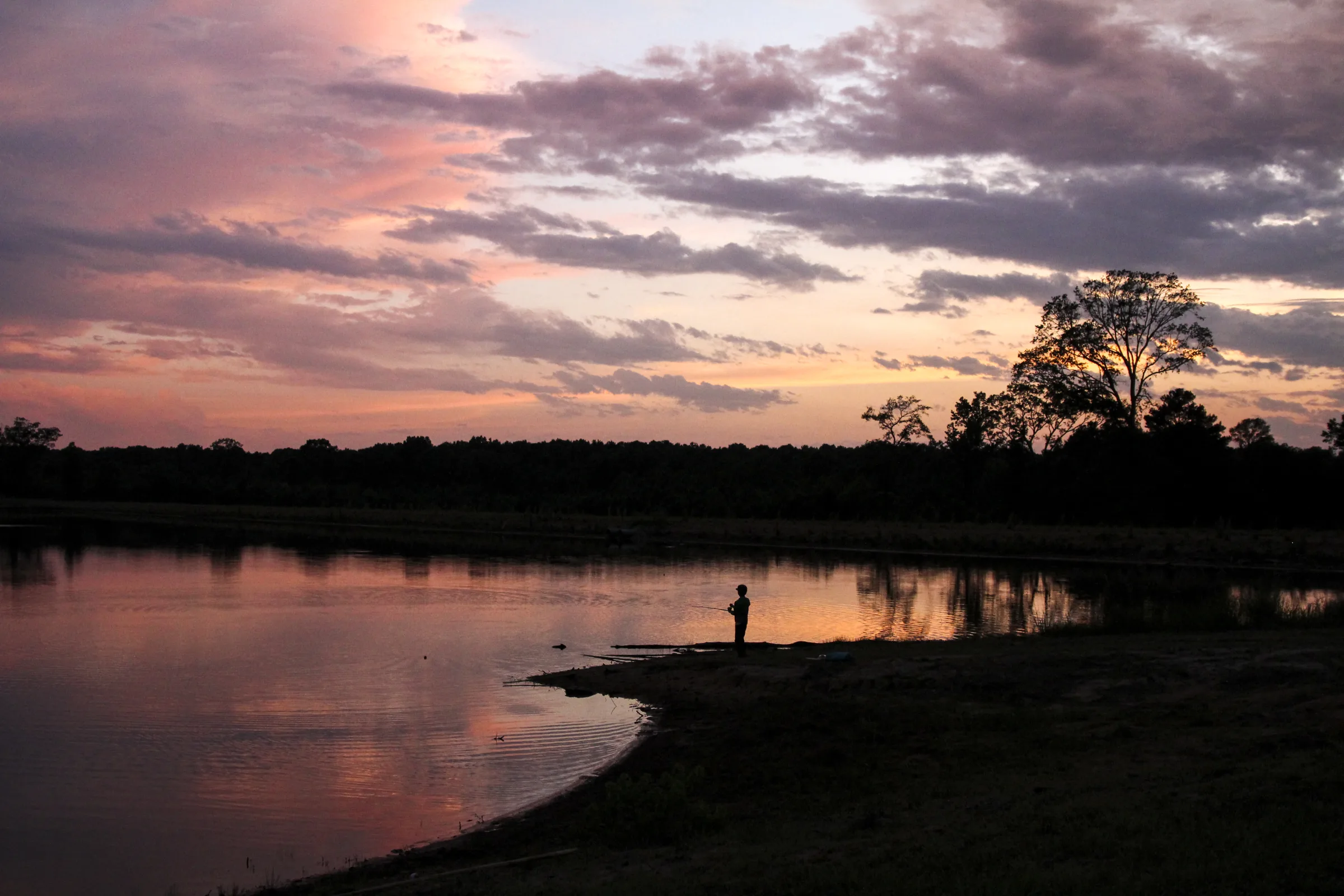
The honest reason is the trade between drive time and difference. Fort Worth families want their child to go somewhere — not to a nicer version of the same landscape they see out the car window every day. The Piney Woods delivers that at three and a half hours: dense forest, private water, real trails, and open-air cabins where the frogs and crickets are the soundtrack and the stars are visible from the porch.
The second reason is the phone policy, and it is the one parents mention most after the first summer. Camp Huawni is completely unplugged. No phones, at all, for the whole session. A camper with a phone has an exit from every uncomfortable moment and a live channel to a parent who cannot actually help from 210 miles away — which tends to extend homesickness rather than resolve it. Take the phone out and something in a cabin changes at about the forty-eight-hour mark. We have written about what kids actually learn in a week without a screen.
What Camp Huawni is
A traditional, coed overnight camp, running since 1965, when Earl and Retha Adams bought the land from its caretaker, cut some logs, built a few cabins, and dug a swimming pool.
- Ages 7–17, in narrow cabin age bands across 14 cabins on Flagpole Hill — nine in girls camp, five in boys camp.
- 100 to 170 campers per session, capped at 100 girls and 70 boys.
- About 50 college-aged staff. A 3.2:1 camper-to-staff ratio last summer; a maximum of 14 campers with 2 counselors per cabin.
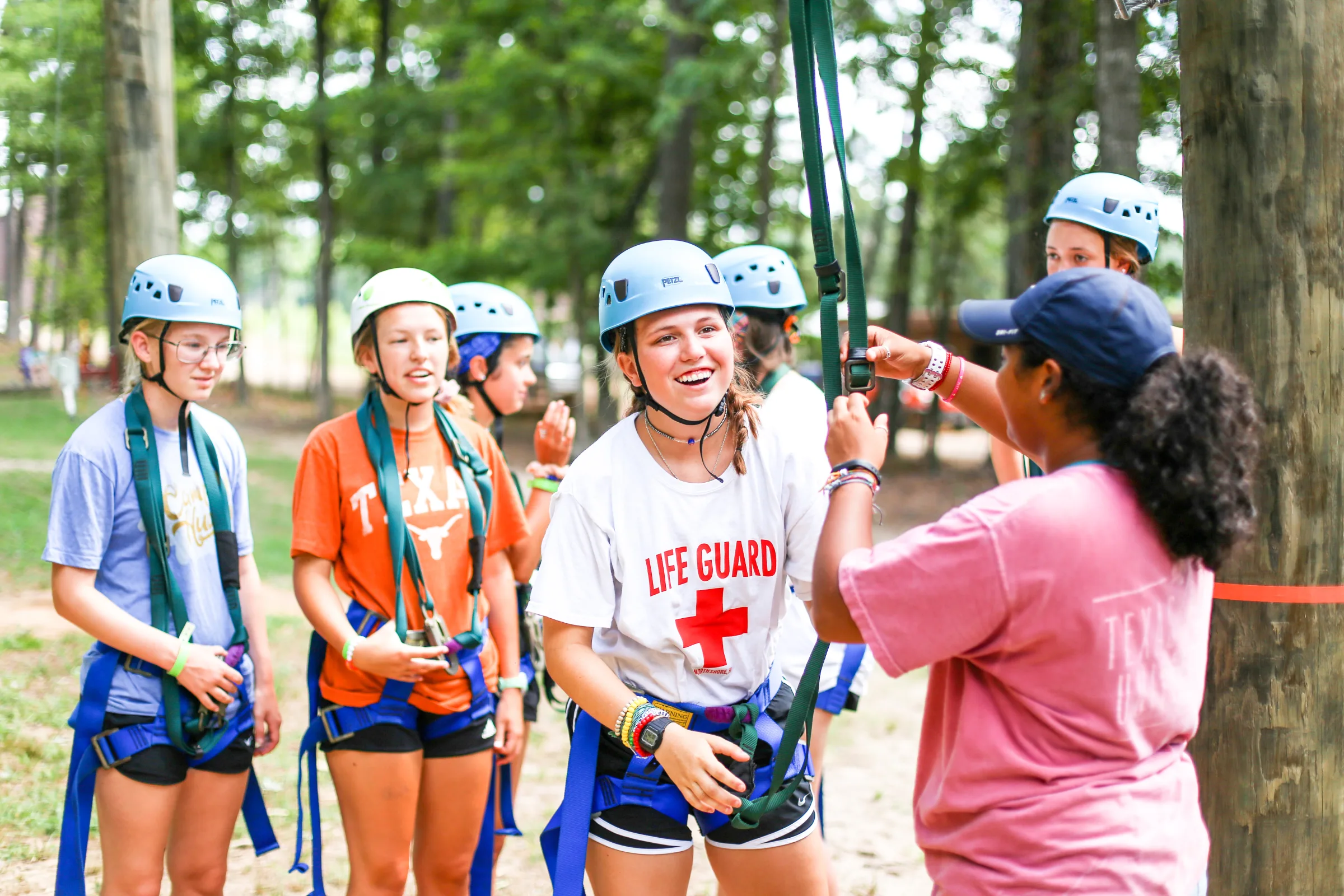
- Six outdoor activity periods a day, from more than twenty: archery on a 14-target course, high ropes and the giant swing, mountain bikes on the trails, canoes and paddle boards on Huawni Pond, the giant water slide into Critter Pond, swimming, volleyball, frisbee golf, hiking.
- Fifteen-plus special events and night activities in a two-week session.
The traditions are the part campers narrate at the dinner table in August: Tribal Competition, where camp splits into the red Caddo and blue Tejas and competes all session for the Golden Pine Cone; Sing Song around the fire; the hike to the Carving Trees, where a camper can carve a name beside one from 1968; Skit Night; the camper triathlon; the Summer Tree on the last night, and Initiation into the Tribe of Huawni.
See the full activity list, what a day actually looks like, or what cabin life is.
Summer 2027 sessions and dates
| Session | Length | Dates (2027) |
|---|---|---|
| Starter 1 | 1 week | May 30 – June 5 |
| Main 1 | 2 weeks | June 6 – June 19 |
| Main 2 | 2 weeks | June 20 – July 3 |
| Main 3 | 2 weeks | July 4 – July 17 |
| Starter 2 | 1 week | July 18 – July 24 |
The two Starter weeks bookend the summer and are the right first session for a newer or younger camper — long enough to make friends and get through a full cycle of traditions, short enough that a nervous first-timer can see the end of it from the beginning.
The Main sessions are two weeks, which is where camp does its actual work. Something reliable happens around day eight or nine: the camper stops being a guest and starts belonging to the place. Main 3 includes the Fourth of July at camp, fireworks over the Piney Woods included.
Summer 2027 rates
| Session | Legacy & Friends (Aug–Nov) |
Early Reg (Dec–Feb) |
Open Reg (Mar–May) |
|---|---|---|---|
| Starter 1 & 2 (1 week) | $1,525 | $1,675 | $1,825 |
| Main 1 (2 weeks) | $3,200 | $3,500 | $3,800 |
| Main 2 & 3 (2 weeks) | $3,000 | $3,300 | $3,600 |
Pricing steps up as summer approaches, so a fall booking saves a few hundred dollars on the identical session. We refund 100% through December 31 — an early commitment is close to risk-free. Full detail lives on the dates and rates page. If cost is the obstacle, our alumni-funded scholarship program opens each fall and is consistently undersubscribed because families assume they will not qualify.
Due diligence
Camp Huawni is licensed and regulated by the Texas Department of State Health Services, and staff are trained in abuse prevention through MinistrySafe. When you compare camps, ask for the cabin ratio rather than the property-wide one — property-wide figures often count kitchen and office staff. Ours is 14 campers to 2 counselors, maximum.
Our safety pages publish the emergency weather plan, activity safety standards, and hiring and training practices rather than making you ask. If you are early in the process, the twelve questions in our parent's guide are the ones we would put to any camp, including this one.

What a session actually looks like
Brochures list activities. What parents are usually trying to picture is the shape of the two weeks.
The first two days are loud and disorienting in the right way — bags to cabins, names learned, the Opening Night Show where the counselors take the stage for an hour of improv and skits. Whatever homesickness is going to appear appears here.
Days three through five are when the rhythm sets: flag raising, six activity periods, rest period after lunch when letters home get written, and a night activity. This is the stretch where a camper stops asking what happens next and starts having opinions about it.
The middle weekend is the turn. A service at the Little Red Church for those who want it, a hike out to the Indian mounds or Turtle Rock, and a slower day. Campers who were homesick on Tuesday are usually unrecognizable by the second Sunday.
The back half is the big traditions — Tribal Competition, the Carving Trees hike, Skit Night, the camper triathlon, the water balloon and shaving cream fight.
The last night is the Summer Tree and Initiation, and it is the one nobody forgets.
Who we are not right for
Worth saying plainly, because a bad fit is expensive for everyone.
A family that wants daily phone contact with their camper will fight our policy all session and have a worse experience than they would at a camp whose policy matches. A child looking for intensive single-sport coaching gets more from a specialty program than from six rotating outdoor activities a day. And a family that needs camp thirty minutes from home should look at the strong day-camp options across Tarrant County instead.
Those are real needs. There are good Texas camps that meet them. We would rather say so in November than have you find out in June.
Getting ready
Two things matter more than the packing list, though our preparing for camp page has that too.
Do not offer a pickup promise. "If you hate it, call and I'll come get you" is the most common well-meant mistake in camp parenting. It hands your child an exit ramp on the one night they are most likely to want it, and almost every homesick camper is unrecognizable by Thursday. Say instead: I will see you on closing day.
Mail a letter the morning of drop-off. From Fort Worth it lands right about when it does the most good. Keep it cheerful, keep it specific, and go easy on how much everyone misses them.
If this is your first time, the first-time parents page covers the questions that come up in the last two weeks, and the photo portal is how you will see your camper during the session.
Ready? See the dates and rates, request the parent packet, or enroll.
Frequently asked questions
- What kinds of summer camps are available in Fort Worth?
- Day camps run by the city and by major institutions — Fort Worth Parks and Recreation, the YMCA, the Fort Worth Zoo and the Fort Worth Botanic Garden among them — plus private school and specialty programmes across Tarrant County. Overnight camps sit outside the metro: the Hill Country is four and a half to five hours southwest, the Piney Woods about three and a half hours east.
- How much do summer camps cost in Fort Worth?
- Day camps generally run about $200 to $500 a week. Traditional overnight camps run roughly $1,100 to $2,000 for a week and $2,600 to $4,500 for two weeks. Camp Huawni publishes its full rate ladder, and one-week sessions start at $1,525 for Summer 2027.
- How far is Camp Huawni from Fort Worth?
- Roughly 210 miles, about three and a half hours. You cross the Metroplex on I-20 and stay on it east past Tyler and Kilgore, then drop south on US-259 and US-59 into Timpson. It is about thirty minutes longer than the same trip from Dallas.
- Is there an overnight camp closer to Fort Worth?
- There are residential programs closer, and plenty of excellent day camps across Tarrant County. Three and a half hours is roughly the distance at which camp stops feeling like an extension of home — which for most families is the reason to send a child in the first place.
- What is the camper-to-counselor ratio?
- Last summer the overall camper-to-staff ratio was 3.2 to 1. The number that matters more is the cabin: a maximum of 14 campers with 2 counselors, in narrow age bands across 14 cabins.
- Do campers have phones at Camp Huawni?
- No. Camp Huawni is completely unplugged — no phones on the property for the entire session. Families stay connected through letters and an online photo portal.
Come see Huawni for yourself
One-week and two-week sessions in the Piney Woods of East Texas, running since 1965. Check this summer's dates and rates, or have us send you the full parent packet.
Keep reading
- The Best Summer Camps in Texas: A Parent's Guide How to compare overnight summer camps in Texas — camp types, session length, real cost ranges, accreditation, ratios, and phone policy — plus a 12-question shortlist you can take to any camp tour. 19 min read
- Dallas Summer Camps: A Parent's Guide A guide to summer camps for Dallas families — the day, specialty and overnight options around DFW, what each costs, when to register, and how to choose between them. 10 min read
- Austin Summer Camps: A Parent's Guide A guide to summer camps for Austin families — day camps in town, Hill Country overnight camps, what each costs, when to book, and when driving east makes sense. 9 min read
- Houston Summer Camps: A Parent's Guide A guide to summer camps for Houston families — the day, specialty and overnight options in and around the metro, what they cost, when to register, and how to pick. 10 min read